Is Now the Time to Buy Bitcoin?
Bitcoin is once again making headlines in mid-2025, trading around all-time highs in the six figures. After a roller-coaster few years, the world’s largest cryptocurrency has staged a powerful rally this year. General investors are now wondering: Is it too late to buy, or is this just the beginning of a new chapter for Bitcoin? To answer that, we need to examine recent price trends, the macroeconomic backdrop, the surge of institutional interest (especially via Bitcoin ETFs), and what respected analysts across crypto and traditional finance are saying about the road ahead. Below, we blend news analysis with expert opinion to evaluate whether now is a good time to invest in Bitcoin.
Bitcoin’s 2025 Surge: New Highs Amid Volatility
Bitcoin (blue line) has rallied roughly 29% year-to-date in 2025, recently hitting record highs above $122,000 – slightly outpacing gold’s ~27% gain over the same period. In fact, Bitcoin and gold are now the top-performing major assets of the year, an unusual pairing that underscores how both risk appetite and safe-haven demand have buoyed markets in 2025. Bitcoin’s climb has been described as a “relentless rally” with “no signs of fatigue,” as it broke one record after another in early July.
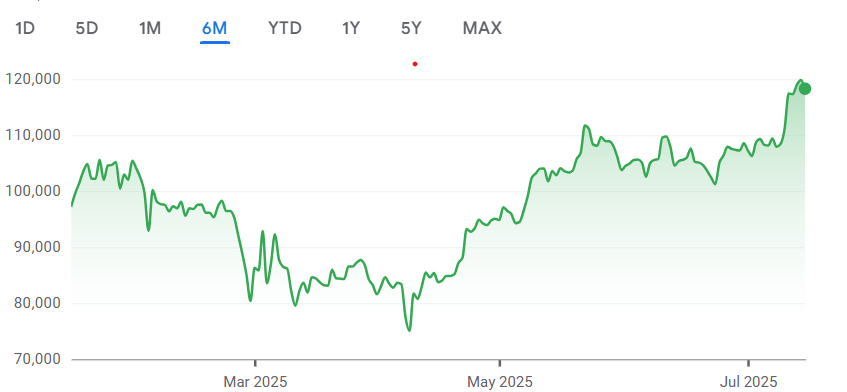
However, the journey upward has not been without turbulence. Earlier in 2025, Bitcoin experienced significant volatility. After a pro-crypto U.S. administration took office in January, BTC surged to historic highs near $109,000, only to plunge below $80,000 during the first quarter amid macroeconomic jitters and crypto-specific shocks. Events like a major exchange hack and uncertainty over Federal Reserve policy triggered steep pullbacks, reminding investors that even in a bull market, Bitcoin can swing by 30% or more in weeks. Those who bought into Bitcoin early this year have still enjoyed strong gains, but they’ve also needed iron stomachs to weather double-digit corrections.
By the second quarter, bullish momentum returned. A confluence of factors – including anticipation of the April 2024 Bitcoin halving (which halved the rate of new BTC issuance) and optimistic macro signals – helped prices not only recover but blast through the elusive $100,000 barrier for the first time. In May, Bitcoin notched a fresh all-time high near $112,000. And as of mid-July, it extended to about $120,000+, setting new records. This rapid climb has sparked a frenzy of interest: headlines tout Bitcoin “overtaking gold” in year-to-date performance, and social media is abuzz with celebration from long-time holders.
Crucially, Bitcoin’s surge has come alongside a broader crypto market revival. Major altcoins like Ethereum have also risen (ETH is up significantly this year, with analysts eyeing $3,000+ targets), although Bitcoin has taken center stage in 2025. BTC’s market dominance – the share of crypto’s total market cap – jumped above 50% for the first time in years, reflecting investors’ preference for the “digital gold” as the safest bet in crypto. Even so, the general risk-on environment has lifted the entire crypto asset class. The overall crypto market capitalization has swelled again, and new projects (from decentralized finance to AI-related tokens) are riding the positive sentiment.
The pressing question for investors now is whether this rally has room to run. On one hand, Bitcoin’s technical trend remains upward – some analysts note that ascending price channels could target $125,000 next, with even $130K–$150K in play if momentum continues. On the other hand, after such a brisk ascent, could a pullback be imminent? Recent trading hints at some cooling: Bitcoin briefly rejected at ~$120K (its highest daily close ever) and slipped back to the mid-$110Ks as traders took profits. In fact, blockchain data shows large holders – “whales” – have started moving coins to exchanges, a sign that some are positioning to sell after the run-up to $122K. Profit-taking by long-term investors has spiked, with one metric indicating that a whopping 98% of the BTC supply was in profit at recent highs – often a precursor to corrections as investors capitalize on gains. This suggests that volatility may be around the corner, even if the bull market trend is intact.
Macro Tailwinds: Inflation, Interest Rates, and Growth Outlook
The macroeconomic backdrop in mid-2025 is a pivotal piece of the Bitcoin puzzle. Over the past few years, Bitcoin has evolved from a fringe asset to something of a macro barometer – sensitive to inflation, interest rates, and the ebb and flow of economic growth. Despite its reputation as “digital gold,” Bitcoin often trades more like a high-octane tech stock in response to macro news, thriving on abundant liquidity and wilting under tight financial conditions. So, what does today’s economy mean for Bitcoin, and vice versa?

Inflation in the U.S. has largely cooled from the peaks of 2022–2023. As of mid-2025, headline inflation sits roughly in the 2.3%–2.5% range – essentially back near the Federal Reserve’s target. This marks a victory in the fight against rising prices, and it’s one reason the Fed has paused its interest rate hikes. In June 2025, the Fed held its benchmark rate steady at about 4.25%–4.50%, after an aggressive campaign of rate increases in prior years. Now, with inflation “not posing a major threat” according to some Fed officials, there’s growing talk of rate cuts on the horizon. Fed Governor Christopher Waller even suggested policymakers could begin easing rates as soon as the summer if economic conditions permit. While such early cuts are not guaranteed, markets widely expect the Fed to start reducing rates by late 2025, barring any surprise resurgence in inflation.
For Bitcoin, this macro shift is critical. The era of rising rates had been a headwind for crypto – higher interest rates increase the appeal of safe yield-bearing assets and strengthen the dollar, both factors that tended to cap Bitcoin’s upside. Now the script is flipping. A pause or pivot to rate cuts is typically bullish for risk assets, including crypto, as it signals easier financial conditions ahead. When the Fed pumps the brakes on tightening (or steps on the gas with easing), liquidity flows more freely. Investors often rotate into stocks, tech, and yes, Bitcoin, seeking higher returns when cash and bonds yield less. Indeed, analysts note that Bitcoin has a positive correlation with falling rates, with one study estimating a potential 13–30% boost in BTC’s price for every 1% cut in Fed rates. We’re already seeing hints of this dynamic: the U.S. dollar has weakened about 10% against other currencies year-to-date, reflecting expectations of looser U.S. policy, and this dollar decline is boosting Bitcoin’s appeal as an alternative asset. A weaker dollar makes globally traded stores of value – whether gold or digital gold – more attractive to investors seeking to preserve wealth.
The economic growth outlook also plays a role. Currently, the U.S. economy is in a delicate balance. Growth has been moderating but not collapsing – a tentative “soft landing” scenario. The Fed’s pause implies it sees the economy as neither overheating nor in freefall. If growth continues at a modest pace with inflation contained, that could be an ideal Goldilocks scenario for Bitcoin: not so hot that the Fed resumes tightening, but not so cold that a recession scares investors away from risky assets. In a risk-on environment where stock markets are climbing (the S&P 500 and tech-heavy Nasdaq have been strong in 2025), Bitcoin tends to do well. In fact, Bitcoin’s correlation with tech stocks has remained high – between March and May 2025, its 30-day correlation with the Nasdaq 100 was over 70%. This means Bitcoin is trading like a “high-beta” version of equities, often rising and falling in tandem with the market’s appetite for growth and technology investments. Thus, if economic sentiment stays upbeat and equities rally, Bitcoin could continue to ride that wave.
Conversely, macro strategists warn that a downturn could spell trouble for BTC. Should the economy slip into recession later in 2025 – a possibility some forecasters haven’t ruled out – the initial reaction might be a broad flight from risk. “During economic downturns, investors flee risk assets, and Bitcoin – viewed as a ‘high-beta play’ on growth – would underperform traditional safe havens like gold,” cautions Peter Berezin of BCA Research. In this bear-case scenario, Bitcoin’s status as a nascent macro asset could hurt: instead of acting like digital gold, it might behave more like a volatile tech stock and see a sharp drop. Some pessimistic projections (e.g. a worst-case model from JPMorgan) imagine Bitcoin falling back toward $45,000 if a recession strikes alongside other negatives (like renewed inflation or regulatory crackdowns). While that dreary outlook is a minority view, it underscores that Bitcoin’s fortunes are now linked to the broader economic cycle more than ever.
In summary, the macro winds in mid-2025 appear to be shifting in Bitcoin’s favor: inflation is under control, the Fed is no longer tightening (and may soon ease), and the dollar is softening – all tailwinds for BTC. The key risk is if those winds reverse (say, an inflation surprise forcing the Fed to stay hawkish, or growth screeching to a halt). For now, though, the macro landscape is giving investors plenty of reason to look at Bitcoin as an opportunity.

Institutional Inflows: Bitcoin ETFs and the Big Money Stampede
Perhaps the biggest change in the investing landscape since the last crypto cycle is the wave of institutional adoption, exemplified by the rise of Bitcoin exchange-traded funds (ETFs). In early 2024, regulators gave the green light to the first U.S. spot Bitcoin ETFs, and this opened floodgates of demand from professional and retail investors alike. By buying shares of a Bitcoin ETF, investors can effectively get exposure to BTC through traditional brokerage accounts, which has dramatically expanded the pool of potential buyers. Midway through 2025, the impact of these instruments is clear: billions of dollars have flowed into Bitcoin via ETFs, providing a steady bid under the market.
Just how large are these flows? U.S.-listed Bitcoin ETFs have brought in over $50 billion in new capital as of mid-2025. That figure is astonishing – it represents automated, long-term demand that simply didn’t exist in past cycles. In the first half of 2025 alone, Bitcoin-focused ETFs attracted about $13.5 billion of inflows, putting them at roughly 70% of the amount that flowed into gold ETFs in the same period. Cumulatively, spot Bitcoin ETFs are nearing $50B in assets under management, rivaling some of the world’s largest gold funds. This trend “underscores the growing confidence in cryptocurrencies as an investment asset,” as one industry report noted.
A look at the leading Bitcoin ETFs tells the story of surging institutional interest. BlackRock’s iShares Bitcoin Trust (ticker IBIT), often credited with kick-starting the ETF race, now holds on the order of $80+ billion in AUM – making it one of the largest single holders of Bitcoin in the world. Other major players like Fidelity’s FBTC and the ARK 21Shares ETF have accumulated tens of billions between them. These funds are not just trading instruments; they are long-term vaults for Bitcoin. Flows into ETFs are considered “sticky” – money that is likely to stay invested for the long haul (think retirement portfolios, institutional allocations) rather than hot money chasing a quick trade. This has two effects beneficial to existing BTC investors: it reduces the supply available on exchanges (since the ETFs must hold the underlying Bitcoin off the market), and it potentially dampens volatility as these funds aren’t prone to panic selling.
The ETF phenomenon is part of a broader picture: Wall Street and corporate treasuries embracing Bitcoin. Institutional titans such as MicroStrategy have continued to add BTC to their holdings even during dips – the company bought another 11,000 BTC in early 2025, bringing its stash to over 460,000 BTC as a strategic reserve. Major banks and asset managers are recommending small Bitcoin allocations to clients for the first time. Notably, BlackRock’s own chief Larry Fink, once a Bitcoin skeptic, has lauded crypto as “digital asset” and pushed a 1–2% portfolio allocation as a viable strategy for diversification (a stance that has further legitimized Bitcoin in the eyes of cautious investors).
Moreover, the ETF flows keep accelerating as Bitcoin’s price climbs, creating a feedback loop. In just one week recently, over $2 billion poured into spot Bitcoin ETFs, according to trading firm QCP Capital – a “clear signal of growing participation” from institutions riding the momentum. These kinds of inflows are unprecedented in crypto’s history. They suggest that unlike past rallies, which were often driven primarily by retail frenzy, the current upswing has deep pockets and professional capital behind it. Every Bitcoin dip in 2025 has so far seen institutional buyers step in, whether via ETFs or direct holdings, reinforcing the idea that a structural bid exists under the market.
For prospective investors pondering entry now, the rise of institutional participation is a double-edged sword. On one side, it strengthens the bull case: Bitcoin is no longer just a playground for day traders and visionaries; it’s an asset class being absorbed by pension funds, hedge funds, and corporations. This lends credibility and could support higher valuations long-term. It’s telling that some analysts now argue Bitcoin’s volatility will gradually decline as more institutional money (with longer time horizons) stabilizes the market. On the other side, the presence of “big money” doesn’t eliminate risk – but it may change its nature. We could see occasional steep selloffs if, for instance, a large ETF experiences outflows or a major institution unwinds a position. So far in 2025, though, the net flow has been into Bitcoin, not out. The key takeaway: Bitcoin has matured into an asset that mainstream investors are buying, which is a stark contrast to just a few years ago. This institutional vote of confidence is a factor tilting the scales in favor of Bitcoin’s long-term investment case.
What Are Experts Saying? Crypto Analysts and Macro Strategists Weigh In
No Bitcoin discussion is complete without gauging what the experts think. This year’s rally has converted some former skeptics and emboldened long-time bulls. Respected voices in both crypto analysis and traditional macro strategy have been sharing their outlooks for Bitcoin – and they’re a mix of optimistic price targets and cautionary notes about potential pitfalls. Here’s a roundup of the current sentiment:
Bullish forecasts have been dominating headlines recently. A growing number of analysts now see Bitcoin climbing well beyond current levels. In fact, $120,000 is considered by many as just a waypoint. Researchers at investment firm Fundstrat and banks like Standard Chartered have released attention-grabbing predictions for year-end 2025: $150,000, $200,000, even $300,000. For example, Standard Chartered (a major global bank) has publicly suggested Bitcoin could reach $200,000 by the end of 2025, citing strong institutional growth and “macro tailwinds” supporting the asset’s rise. Bitwise CIO Matt Hougan, another closely followed analyst, similarly projects ~$200K Bitcoin, attributing it to the combination of robust ETF-driven demand and long-term capital inflows into the space. These are not fringe figures but mainstream finance voices, which gives their bullish outlook more weight than the ultra-optimistic calls seen in earlier hype cycles. The consensus among a cadre of these experts is that Bitcoin’s fundamentals – limited supply, expanding adoption, and a friendly macro landscape – could drive significantly higher prices over the next 6–12 months. Some Cointelegraph market analysts, for instance, see technical patterns that point to a possible $130K–$150K range in the coming months if Bitcoin’s breakout continues.
Proponents of the bull case often highlight a few key drivers behind their optimism. First is the ETF effect: as discussed, the absorption of new supply by ETFs creates a supply-demand imbalance that favors price appreciation. “Spot Bitcoin ETFs are absorbing new supply,” noted one report, adding that this steady, automated buying reduces selling pressure and supports an upward trend. Second, macro policy shifts are seen as a catalyst – if the U.S. Federal Reserve indeed pivots to cutting rates, that could “be Bitcoin’s best friend,” as easy money historically correlates with crypto rallies. Some analysts even speculate that central banks or sovereign wealth funds might start buying Bitcoin in the future as part of their reserves, especially in countries facing currency instability, which would be an game-changer for demand. And third, the post-halving supply squeeze is in play: Bitcoin’s block reward halving in 2024 means fewer new BTC entering circulation each day, at a time when demand is rising. This scarcity dynamic has preceded major bull runs in the past, and 2025 appears to be following suit – one reason several experts believe the second half of this year and 2026 could see outsized gains.
But not everyone is convinced that the only path is up. There are sober voices urging caution, too. Bitcoin may be booming, but it still faces meaningful risks that could make “now” a bad time to buy at the top – if those risks materialize. A prominent concern cited by macro strategists is the possibility of an economic downturn. As noted earlier, Bitcoin now behaves much like a risk asset, so a recession could deal it a heavy blow. BCA Research’s Peter Berezin warns that if the U.S. enters a recession in 2025, Bitcoin could plummet perhaps on the order of 50% or more from its peak, given its correlation to the high-flying tech sector. His view is that in a true risk-off scenario, Bitcoin’s correlation with equities (especially tech stocks) “turns toxic” – meaning BTC would likely fall harder than the stock market, rather than act as a safe haven. Similarly, analysts at JPMorgan have sketched out a scenario where Bitcoin could retrace to the $45,000 range – this would entail a combination of factors like sticky inflation forcing the Fed to keep rates high longer (dimming the appeal of Bitcoin), plus regulatory setbacks or waning institutional enthusiasm. On that note, inflation is a two-edged sword for BTC: while moderate inflation helps by pushing the Fed to ease, a re-acceleration of inflation would hurt by prompting tighter policy and reducing Bitcoin’s appeal as an inflation hedge (especially since Bitcoin’s track record as a reliable hedge is mixed). As one report put it, if U.S. inflation rises back above ~3%, the Fed might delay cuts and “undermine Bitcoin’s liquidity-driven rally”.
Regulatory and political factors also feature in expert debates. Thus far in 2025, crypto regulation in the U.S. has shown signs of turning more constructive – with new bills in Congress aiming to clarify crypto rules and even talk of a potential U.S. government Bitcoin reserve or favorable tax treatment. These have been tailwinds. But the opposite outcome is still possible. Skeptics point out that a sudden regulatory crackdown (for instance, on crypto exchanges, stablecoins, or Bitcoin mining for environmental reasons) could quickly sour market sentiment. Globally, there are known unknowns: if another major economy were to ban or restrict crypto usage, it could dampen demand. Even competition from other technologies is raised as a caution: as central banks roll out CBDCs (central bank digital currencies) or as other crypto networks (like Ethereum or newer “Web3” projects) gain traction, some wonder if Bitcoin’s dominance could be eroded in the long term. While Bitcoin has the first-mover advantage as digital gold, it’s not the only game in town for blockchain investment.
Finally, some crypto analysts are cautious in the short run precisely because of how euphoric the market has become. When virtually everyone turns bullish and leverage builds up, contrarians start to prepare for a pullback. On-chain data currently shows a lot of holders in profit (nearly the entire supply), which historically precedes at least a minor correction as many investors will try to lock in gains. We already noted whales sending coins to exchanges – that can foretell increased selling. Market technicians are watching support levels like $108,000; popular trader Michaël van de Poppe noted that as long as Bitcoin stays above ~$108K, the bullish trend remains intact, but a drop below that could signal a deeper correction in play. “Volatility [is] incoming,” he wrote, though he added that a dip here would be “something to worry [about]? Definitely not,” implying it’d likely be a healthy pullback in an ongoing bull market. In essence, even bulls expect some choppiness – a chance for latecomers to potentially buy dips if they occur.
Risks and Considerations for Investors
Given the mix of upbeat drivers and looming risks, what should an everyday investor consider before deciding if now is the time to buy Bitcoin? Here’s a quick checklist of key factors and risks to weigh:
- Macroeconomic Shifts: Keep a close eye on the Fed and inflation data. If inflation stays tame or the Fed clearly signals rate cuts, that’s a positive sign for Bitcoin (lower rates and higher liquidity can fuel crypto rallies). Conversely, any hawkish surprises – say inflation flaring up again or the Fed hinting at hiking further – could rain on Bitcoin’s parade by strengthening the dollar and drawing money back to bonds. The health of the economy matters too: a severe recession could temporarily hit Bitcoin along with stocks.
- Technical Corrections: Bitcoin has run up very fast, and short-term technical indicators show some overbought conditions. Analysts have noted things like an overextended RSI and even a bearish momentum divergence on high-timeframe charts. These technical signals don’t negate the long-term bull case but suggest that a pullback to support levels (for example, the $100K–$110K zone) could happen before the next leg higher. New investors might consider phasing into a position rather than going “all-in” at once, to mitigate the timing risk.
- Market Sentiment & Volatility: Crypto markets are known for rapid sentiment shifts. As of now, sentiment is strongly bullish – perhaps too bullish. Almost everyone is talking about further gains (some even calling this the early stages of a new “crypto spring”). While optimism is generally warranted by fundamentals, extreme greed can lead to crowded trades. The presence of leveraged bets can exacerbate swings. Prospective buyers should be mentally prepared for high volatility; double-digit dips can occur without warning. If you do buy, setting an appropriate stop-loss or sizing your position such that you can hold through volatility is wise.
- Regulatory Environment: Continue monitoring regulatory developments. The trajectory in the U.S. has turned more positive – with pending legislation (like the CLARITY Act and others) aiming to legitimize crypto markets, and the new administration showing support for crypto innovation. These have the potential to remove clouds of uncertainty and even catalyze rallies on good news. However, regulation remains a wildcard. If, for instance, a major country were to ban Bitcoin transactions or heavily tax crypto holdings, it would be a negative shock. So far, that seems low probability in major economies, but investors in Bitcoin should remain adaptable to changing rules.
- Competition and Innovation: Bitcoin is the leader, but it isn’t standing alone. The broader crypto ecosystem is evolving, and sometimes capital flows into other sectors (like decentralized finance, NFTs, or whatever the next hot trend is) could divert some attention from Bitcoin. That said, Bitcoin’s unique role as a store-of-value asset and institutional favorite gives it an edge that most altcoins lack. It’s also worth noting that if Ethereum or other networks see their own ETF approvals (Ethereum ETF applications are indeed in the pipeline), it could spur fresh inflows to those assets too. This isn’t so much a direct risk to Bitcoin’s value as it is a reminder that the crypto market offers many opportunities – but Bitcoin remains the bellwether for now.
In weighing these factors, it’s clear that investing in Bitcoin today carries both significant upside potential and downside risk. The asset has matured and is supported by serious economic forces in a way it never was in, say, 2017 or even 2021. Yet, it’s still volatile and sensitive to both crypto-specific issues (like security breaches or network updates) and macro shocks.
Conclusion: A Pivotal Moment for Bitcoin Investing
So, is now the time to buy Bitcoin? It depends on your perspective and risk tolerance. On balance, many in the investing community argue that mid-2025 presents a compelling opportunity. Bitcoin has strong momentum, a favorable macro wind at its back (with inflation down and interest rate relief in sight), and unprecedented institutional support via ETF flows and corporate adoption. The narrative of Bitcoin as “digital gold” and an inflation hedge has regained appeal as U.S. fiscal challenges and currency debates persist. In plain terms, the fundamental case for Bitcoin has arguably never been stronger: demand is rising, supply growth is halving, and Wall Street is onboard.
Analysts with an upbeat outlook believe the current rally could be just the beginning of a larger cycle. Price targets of $120K–$150K by later this year are now commonplace, and even $200K is no longer dismissed as fanciful by reputable strategists. If those forecasts even partly come true, buying at ~$110K–$120K could look wise in hindsight. Long-term believers often emphasize that today’s price may feel high, but in the context of Bitcoin’s 16-year history, each peak eventually has been eclipsed by the next. They see Bitcoin carving out a role in the global financial system – as a hedge, as a store of value, as an investment asset class – and thus expect its value to appreciate over time in a secular uptrend.
On the other hand, prudent investors will also recognize the risks. After such a rapid run-up, one should be prepared for a pullback. If you fear buying the top, a sensible approach might be dollar-cost averaging – investing a fixed amount at regular intervals – to mitigate the impact of short-term price swings. It’s also perfectly reasonable to take a “wait and see” approach for a better entry, especially if you believe a market correction is due. Remember that even bull markets have corrections; a 10-20% dip from all-time highs would be normal market behavior and could present a more attractive entry point than the literal peak. Risk management is key: Bitcoin can be part of a portfolio, but sizing the position appropriately (so that a downturn wouldn’t be ruinous) is crucial, as is having a long-term conviction to hold through volatility.
In the end, whether now is the time to buy Bitcoin comes down to how you balance the strong positives – macro tailwinds, institutional flows, favorable sentiment – against the potential negatives – short-term froth, macro uncertainty, and regulatory unknowns. For many general investors with a high risk tolerance and a long-term horizon, initiating or adding to a Bitcoin position in mid-2025 can be justified by the thesis that we are in an early-to-mid stage of a broader crypto bull market cycle. As one crypto trading firm noted this week, “the bull market is here”, and the market may have underestimated the strength of this move fueled by technical breakouts and institutional demand.
That said, timing any market is tricky. Our opinion is that Bitcoin today offers an intriguing opportunity, but not a free ride. If you decide to buy now, go in with eyes open: use it as a chance to invest prudently rather than gamble. If you choose to wait, keep Bitcoin on your radar – conditions are shifting fast, and sitting on the sidelines carries its own risk of missed upside. In the dynamic dance between Bitcoin and the macro economy, 2025 is shaping up to be a pivotal year. Whether you step onto the floor now or later, one thing is clear: Bitcoin has firmly entered the mainstream investing conversation, and ignoring it is no longer an option.

Bottom line: For investors who believe in Bitcoin’s long-term story, the current environment provides multiple tailwinds that make a compelling case to consider buying – albeit with a dose of caution. Now might indeed be the time to get off zero, if you haven’t already – just be prepared to hold on tight for the ride.
Sources:
- Phemex Blog – Bitcoin Price Prediction 2025: Analyzing the Next Moves for BTC
- Cointelegraph – Bitcoin rally to $120K possible if Fed eases rates
- Cointelegraph – Bitcoin shows no signs of fatigue as it overtakes gold in 2025
- Cointelegraph – Bitcoin price drop to $114K possible as whales take profits
- Blockchain Council – Experts Predict Bitcoin to Hit $200K by Year-End 2025
- AInvest – Bitcoin’s 2025 Crossroads: $150K or $45K?
- TradingView News/Coinpedia – Fed Rates Unchanged – Impact on Bitcoin
- AInvest – ETFs Poised to Surpass $1 Trillion in 2025 (Bitcoin ETF inflow data)
- Cointelegraph – Bitcoin ‘relentless rally’ and ETF inflows
- Amberdata Q1 2025 Report – Historic Highs and Volatility





Leave a comment